

 日本語
日本語
When a company decides to build custom software, the first question is rarely about features. Instead, it is about process.
How does the software development process actually work? What happens at each stage? And what will we receive when it is done?
These are fair questions. So here is a clear, honest answer.
What the Software Development Process Looks Like at Solashi
Solashi follows a structured 9-stage software development process. Each stage has defined activities. Each stage produces clear deliverables. And nothing moves forward without sign-off.
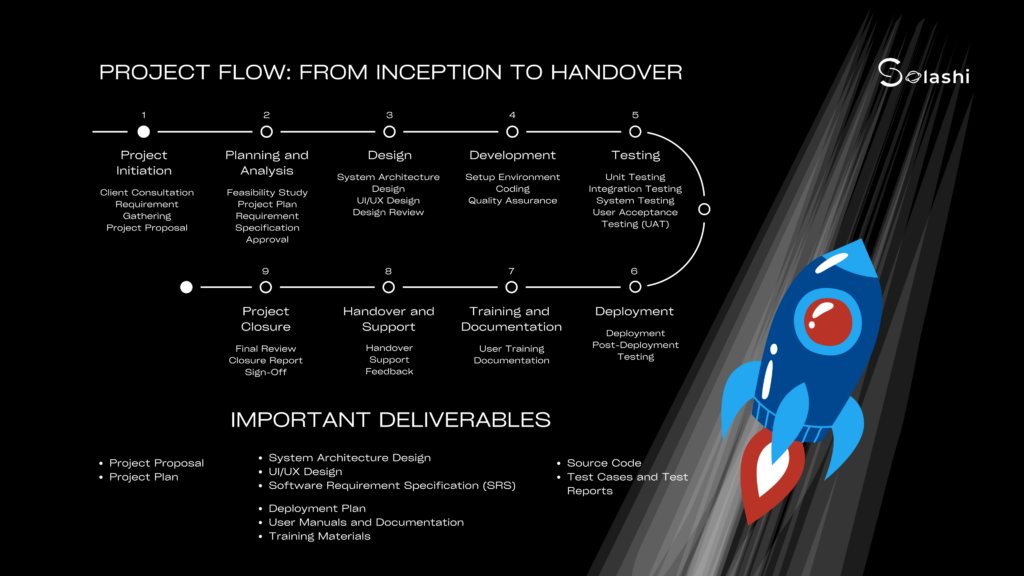
Image from Solashi Holdings ‘ Pinterest
Here is what each stage involves.
Stage 1: Project Initiation
The software development process starts with a conversation.
First, your team meets ours. Together, we gather requirements and align on scope, goals, and constraints. Then we produce a Project Proposal – a written document that defines what we are going to build and why.
Deliverables: Project Proposal
Stage 2: Planning and Analysis
Next, we go deeper into the details.
We run a feasibility study to check that the proposed solution is viable. After that, we write the Project Plan and the Requirements Specification. Both documents go through client approval before we move forward.
This stage matters. In addition, it protects both sides because unclear requirements are the single biggest cause of failed software projects.
Deliverables: Project Plan, Requirements Specification
Stage 3: Design
At this stage, the software development process becomes visual.
Our team designs the system architecture: how the components fit together. We also produce the UI/UX design, so you can see exactly how the product will look and feel. Finally, a design review closes the stage before development begins.
Deliverables: System Architecture Design, UI/UX Design
Stage 4: Development
This is where the build begins.
We set up the environment, write the code, and run continuous quality assurance throughout. However, development does not happen in isolation, your team stays informed at every step. Similarly, any changes to scope are flagged and agreed before work continues.
Deliverables: Source Code (in progress)
Stage 5: Testing
Before anything goes live, it goes through four layers of testing.
First, unit testing checks individual components. Then, integration testing checks how they work together. After that, system testing checks the full product. Finally, User Acceptance Testing (UAT) gives your team the chance to validate everything against the original requirements.
Deliverables: Test Cases and Test Reports
Stage 6: Deployment
When testing is complete, we deploy.
The software goes live in your environment. Subsequently, we run post-deployment testing to confirm everything works as expected in production. Moreover, we stay available during this period to catch anything that needs a fast fix.
Deliverables: Deployed Product
Stage 7: Training and Documentation
A good product is only useful if your team knows how to use it.
So we provide user training and full documentation. As a result, your team learns the system thoroughly. Moreover, the documentation stays with you long after the project ends.
Deliverables: User Manuals, Training Materials, Documentation
Stage 8: Handover and Support
At this stage, ownership transfers to you.
We hand over the source code, all documentation, and access to all systems. Furthermore, we provide a support period to cover any questions or issues that come up after go-live. In addition, feedback from this stage informs any future improvements.
Deliverables: Full Handover Package, Support Period
Stage 9: Project Closure
The final stage of the software development process is formal closure.
First, we run a final review together. Then we produce a Closure Report. After that, both sides sign off. Finally, the project is complete.
Deliverables: Closure Report, Sign-Off
The Full Deliverables List
Across all nine stages, here is what Solashi delivers:
- Project Proposal
- Project Plan
- System Architecture Design
- UI/UX Design
- Software Requirements Specification (SRS)
- Deployment Plan
- User Manuals and Documentation
- Training Materials
- Source Code
- Test Cases and Test Reports
Why a Structured Process Matters
Many software projects fail not because the team lacked skill, but because the process lacked structure.
When the software development process is clear, both sides know what to expect at every stage. As a result, scope stays controlled. Timelines stay realistic. And the final product matches what was agreed at the start.
Consequently, Solashi’s clients receive what they asked for: on time, with documentation, and with a team that stays accountable from first meeting to final sign-off.
See how this process produces a real working product: CRM for Logistics: How Solashi Built FreightView
Ready to start your software development process? Book a 20-minute consultation with Solashi and let us show you how we work.
FAQ
Q1: How long does the software development process take?
The timeline depends on the scope and complexity of the project. A focused custom tool or client portal typically takes 8 to 16 weeks from project initiation to deployment. Larger enterprise systems with complex integrations may take 6 to 12 months. At Solashi, we define the timeline during Stage 2 – Planning and Analysis – and lock it into the Project Plan before development begins. As a result, both sides have a clear, agreed schedule before any code is written.
Q2: What is the difference between system testing and UAT?
System testing is carried out by the development team. It checks whether the full product works as designed — covering functionality, performance, and integration between components. User Acceptance Testing (UAT), by contrast, is carried out by the client. It validates that the product meets the original business requirements and works correctly in real-world conditions. Both are essential. However, UAT is the final checkpoint before deployment – it gives the client direct control over the go/no-go decision.
Q3: Who owns the source code after the project ends?
At Solashi, the client owns the source code. Full ownership transfers during Stage 8 – Handover and Support. This includes the source code, all documentation, system architecture files, and access to all environments. Nothing is withheld after sign-off. The client is free to maintain, modify, or extend the product with any team they choose.
Q4: What happens if requirements change during development?
Scope changes are a normal part of software projects. At Solashi, any change to the agreed requirements is flagged, documented, and approved by both sides before work continues. This is built into Stage 4 – Development – as a standard control. Changes that affect timeline or budget are discussed openly before they are implemented. As a result, there are no surprise invoices or missed deadlines caused by undocumented changes.
Q5: What documents will I receive at the end of the project?
Across all 9 stages, Solashi delivers: a Project Proposal, Project Plan, System Architecture Design, UI/UX Design files, Software Requirements Specification (SRS), Deployment Plan, User Manuals, Training Materials, Source Code, and Test Cases and Test Reports. Every deliverable is reviewed and approved before the project moves to the next stage. Nothing is handed over without prior agreement on quality.
Q6: Do I need a technical background to work with Solashi?
No. Solashi works with business owners, operations managers, and non-technical decision makers regularly. Our process is designed to translate business requirements into technical solutions — not the other way around. During Stage 1 and Stage 2, we handle the translation from your business goals into a technical specification. You review and approve in plain language. Your team does not need to understand the code – only the outcomes it produces.
Q7: What is the difference between fixed-cost and time-and-materials software development?
Fixed-cost development means the scope, timeline, and price are agreed upfront. You know exactly what you will receive, when, and for how much. Time-and-materials development bills by hours worked, with scope that can flex during the project. Solashi’s structured 9-stage process is designed to support fixed-cost delivery because clear requirements, defined deliverables, and stage-by-stage sign-offs make accurate scoping possible from the start.

