

 日本語
日本語
AI search optimization, or AISEO, is how brands get cited by AI systems in 2026. Google AI Overviews now appear in 25.11% of all searches. ChatGPT processes 2.5 billion queries every day. Nearly half of all B2B buyers use AI tools to research vendors before speaking to anyone.
If your brand does not appear in AI-generated answers, you lose pipeline before the conversation starts. Therefore, this article explains how to build for AI search. It also covers why Solashi created the #BuildForAISearch framework to help businesses win this emerging category.
Quick Summary: The #BuildForAISearch Cheat Sheet
AI tools change search. AI agents now read and share your content.
Keywords are not enough. AI looks for trust, facts, and clean data.
AI visitors buy more. Traffic from ChatGPT has very high intent.
Put answers first. Put a short summary at the top of each section.
Write headers as questions. Match the exact things people ask AI.
Keep sentences short. Use clear words and skip the fluff.
Use data tables. AI tools copy and paste tables easily.
Show the date. Always display a fresh “Last Updated” timestamp.
Test your brand. Type your top prompts into ChatGPT to check your rank.
What Is AISEO and Why It Matters in 2026
AISEO stands for AI Search Engine Optimization. In short, it means optimizing content so that AI agents, LLMs, and generative search platforms cite your brand in their answers.
Traditional SEO focused on keywords and backlinks. AISEO focuses on trust and structure. However, the two disciplines share some foundations. Therefore, teams with strong SEO already have a head start.
The numbers confirm the shift. AI referral traffic grew 527% year-over-year between January and May 2025. In addition, LLM visitors convert at 15.9% from ChatGPT, compared to 1.76% from organic search. The intent signal from AI visitors is far higher.
For B2B teams specifically, the impact is direct. 73% of B2B buyers now use AI tools like ChatGPT and Perplexity to research vendors. Furthermore, when an LLM surfaces a vendor a buyer had not considered before, 51% go directly to that vendor’s website. As a result, AI citation has become a new top-of-funnel channel.
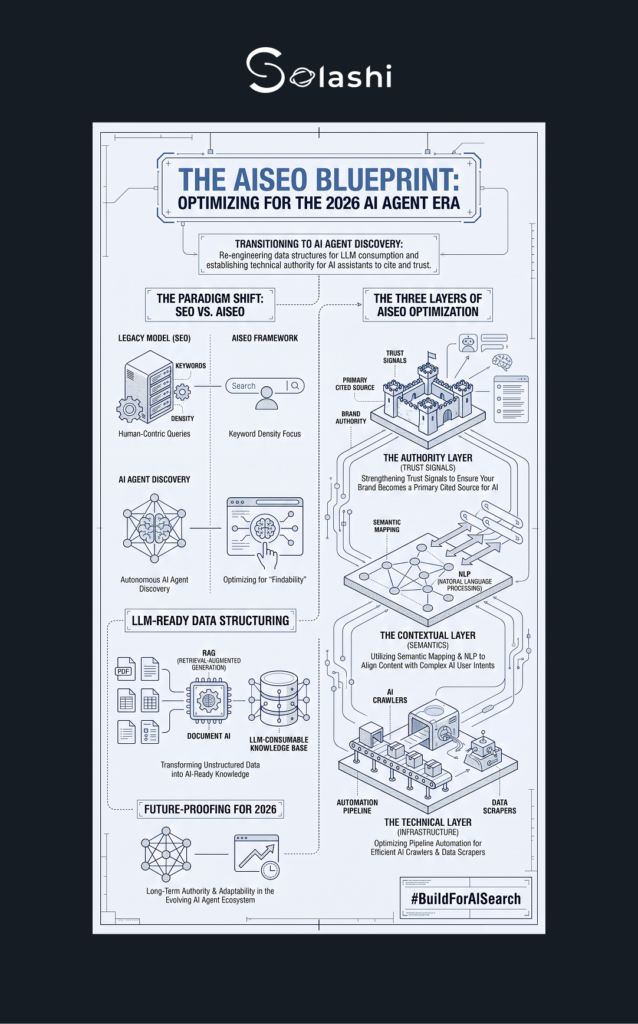
The Paradigm Shift – SEO vs. AISEO
Legacy SEO matched keywords to pages. AI search works differently. AI agents look for trusted sources, clear answers, and consistent entity signals – not keyword density.
Therefore, the optimization target changes. In SEO, success means ranking in position 1. In AISEO, success means being cited as a primary source in an AI-generated answer.
Three key differences stand out.
First, backlinks mattered most in SEO. In AISEO, brand search volume is the strongest predictor of AI citations, with a 0.334 correlation to LLM visibility. In addition, establishing entity presence across 4+ third-party platforms increases AI citation likelihood by 2.8x.
Second, AI Overviews are reducing the value of traditional rankings. When AI Overviews appear, organic click-through rate drops from 1.41% to 0.64%. Consequently, ranking in position 1 delivers less traffic than it did two years ago.
Third, the introduction of every page now carries more weight than ever. Specifically, 44.2% of all LLM citations come from the first 30% of a piece of content. Therefore, the opening paragraph is the most strategically important section on any page.
The Three Layers of AI Search Optimization
Solashi’s AISEO Blueprint organizes optimization into three layers. Each layer addresses how AI agents discover and cite content. Together, they form the #BuildForAISearch framework.
The Authority Layer – Trust Signals
The Authority Layer builds trust signals so that AI systems recognize your brand as a primary cited source.
Trust signals include domain authority, entity presence across platforms, and consistent brand mentions across the web. Specifically, brands in the top quartile for web mentions receive over 10x more AI Overview citations than those in the second quartile.
For businesses, building the Authority Layer means maintaining a consistent entity footprint. This includes publishing on LinkedIn, earning coverage in industry publications, and keeping brand information consistent across every platform. In addition, distributing content widely can increase AI citations by up to 325% compared to publishing only on your own site.
The Authority Layer takes the longest to build. However, it is also the most durable. The average domain age of ChatGPT-cited sources is 17 years. Therefore, the time to start is now.
The Contextual Layer – Semantics
The Contextual Layer aligns content with how AI users actually search. AI queries average 10.9 words in length, compared to 3-4 words for traditional Google searches. Users ask full questions, not keywords. Therefore, content must answer those questions directly.
Semantic optimization means writing H2 headings as real questions. It also means opening each section with a direct 30–80 word answer before providing deeper context. Furthermore, structured lists, comparison tables, and FAQ sections help LLMs extract answers easily.
For Solashi’s own content, this layer informed every blog article published in 2026. Each H2 now reflects a genuine user question. Each introduction opens with the most important statement first. As a result, AI systems can extract relevant answers from any section without reading the full article.
The Technical Layer – Infrastructure
The Technical Layer ensures AI crawlers can access, read, and index your content without friction.
Schema markup is the first priority. Specifically, FAQPage and Article schema give AI crawlers structured signals about content type and intent. Page load speed matters next, because AI crawlers deprioritize slow pages. In addition, clean URL structures that match H1 headings give AI systems early relevance signals.
“Last Updated” timestamps also belong in this layer. They signal content freshness, which AI systems use to assess citation worthiness. Furthermore, LLM-ready data structuring – converting unstructured documents into RAG-ready formats – helps AI agents consume and cite internal knowledge bases.
For technical teams, the priority order is clear. Fix schema first, then page speed, then URL structure, then content formatting. Each step compounds on the one before it.
LLM-Ready Data Structuring in AI Search
LLM-ready data structuring is one of the most underestimated parts of AISEO. Traditional content was written for humans who scroll and skim. LLMs, however, parse structure and extract entities. Therefore, content that reads well for humans may still be invisible to AI if it lacks the right structural signals.
Three practices make content LLM-ready.
First, transform unstructured documents – PDFs, reports, knowledge base articles — into formats that retrieval-augmented generation systems can index. Second, organize content around entities rather than keywords so that AI systems can map it to the right topics. Third, update content regularly and signal those updates through schema and visible timestamps.
For businesses with large content libraries, this is typically the highest-leverage AISEO investment. A well-structured knowledge base that AI systems reliably cite is more valuable than dozens of individually optimized pages. For context, see how Solashi applies these principles in our AI-assisted SDLC process.
Future-Proofing for the 2026 AI Agent Ecosystem
The AI search landscape changes fast. Between 40% and 60% of cited sources change month-to-month across Google AI Mode and ChatGPT. Therefore, future-proofing means building long-term authority rather than chasing short-term citation wins.
Three principles guide this work.
First, build entity authority consistently over time. Citations follow entities that AI systems trust. Trust comes from consistent presence, consistent messaging, and consistent coverage across multiple platforms.
Second, update content on a regular cadence. AI systems weight freshness. High-value pages should be reviewed and updated every six to twelve months. Each update should also trigger a schema refresh.
Third, optimize for multiple AI platforms separately. Only 11% of domains are cited by both ChatGPT and Perplexity. Therefore, platform-specific optimization is essential, not optional.
How Solashi Applies Build For AI Search
Solashi built the #BuildForAISearch framework from direct implementation experience. The team applied AISEO principles to solashi.com and to client content strategies throughout 2025 and 2026.
The framework covers the full stack. It includes Authority Layer trust signal building, Contextual Layer semantic restructuring, and Technical Layer infrastructure optimization. For clients, Solashi implements this as a structured engagement – starting with an AI visibility audit, then identifying gaps, then executing a prioritized roadmap.
For teams just starting out, three quick wins deliver the most immediate impact. First, add FAQPage schema to your highest-traffic pages. Second, rewrite every H2 heading as a genuine user question. Third, add a “Last Updated” date to every content page. Each of these takes less than a day to implement. However, each one signals immediately to AI crawlers that the content is current, structured, and citable.
For a closer look at how Solashi structures content for AI readability, see our guide to 9 critical stages in a complete software development process.
Next Steps: How to start with AISEO today
Do not wait. AI search is here now.
Fix your site today. Start with small steps.
Change your headers first. Turn them into questions.
Add your code schema. Help AI bots find your facts.
Keep your text simple. Use clear words on every page.
Update your old posts. Give them a fresh date stamp.
Check your rank. Type your name into ChatGPT each week.
Win more traffic. Ready buyers are looking for you.
How Solashi Helps Businesses Win AI Search
Solashi builds custom software and AI-powered systems for businesses across logistics, manufacturing, healthcare, and enterprise operations. In addition, Solashi applies the #BuildForAISearch framework to help clients structure their digital presence for AI discovery.
If your business needs a technology partner that understands both software delivery and AI search visibility, Solashi is ready to help.
In Short: Why You Must Act Now
AI search is changing everything fast. So, old SEO methods are failing now. But, you can fix your site easily. First, turn your headers into real questions. Next, add clear answer blocks right below them. Also, show a fresh date on every page. In fact, these small steps bring massive traffic. Because of this, ready buyers will find you first. Then, your sales pipeline will grow quickly.
Therefore, Let’s Review: Your Quick AISEO Action Plan
Traditional search is changing fast. Therefore, you must update your site today. First, fix your main headers. For example, turn them into real questions. Then, write a short summary block. Also, keep your sentences very short. In addition, use clean data tables. As a result, AI bots can find your facts. Furthermore, show a fresh date stamp. So, your content will look new. In fact, these small steps bring big traffic. Thus, your sales pipeline will grow. In short, you must build for AI now.
The Bottom Line
AI tools are changing the web fast. You must adapt right now. Keep your text short. Keep your facts clear. Put your best answers first. Do not use long words. Write the way a real human talks. This is exactly how your brand wins.
Follow Solashi Across Platforms
Solashi publishes content across four platforms. Each one covers a different angle of our work.
On LinkedIn, we share technology insights, case studies, and updates from the Solashi team. Follow us for posts on AI, software development, and enterprise operations.
On Pinterest, we publish visual references from real projects – dashboards, design systems, IoT monitoring interfaces, and original tech infographics. The account reached 7,100 monthly views in its first three weeks.
On Instagram, we share behind-the-scenes content from the Solashi team – events, culture, and company life.
On Facebook, we post company news and updates for a broader audience.
Follow us on the platforms that fit your workflow. We publish new content every week across all channels.
Frequently Asked Questions About AI Search Engine Optimization
What is the difference between SEO and AISEO?
SEO optimizes content to rank in search results. AISEO optimizes content to be cited by AI systems in generated answers. Both share technical foundations, but they require different content structures and authority-building strategies.
Traditional SEO targets keyword rankings on Google. AISEO, however, targets citation frequency in ChatGPT, Perplexity, Google AI Mode, and other LLM platforms. Furthermore, as AI Overviews reduce click-through rates on traditional organic results, AISEO becomes an increasingly important complement to conventional SEO.
How do I know if my content is being cited by AI systems?
Search for your brand and key topics manually in ChatGPT, Perplexity, and Google AI Mode. Dedicated tracking platforms such as BrightEdge, Semrush AI, and Wellows provide automated citation monitoring across multiple LLM platforms.
Start by submitting 20 to 30 queries that your ideal clients are likely to ask AI systems. Then check whether your brand appears in the answers. This gives you an immediate baseline before any optimization work begins.
What content format does AI search prefer?
AI systems prefer short sentences under 20 words, H2 headings phrased as direct questions, 30–80 word answer blocks at the start of each section, structured lists and tables, and FAQPage schema.
The introduction carries the most weight. Specifically, 44.2% of all LLM citations come from the first 30% of a page. Therefore, the opening paragraph should contain the most important statement – not background context or preamble.
How long does it take to see results from AI search?
Schema and URL fixes improve AI crawlability within days. Authority signal building takes months. Citation frequency in major LLMs typically shows measurable improvement within 90 to 180 days of consistent implementation.
AISEO is not a one-time project. Instead, it is an ongoing discipline that compounds over time. Consequently, the brands that build AI citation authority now will be significantly harder to displace as AI search becomes the dominant discovery channel.
Why are AI search prompts so long?
People talk to AI tools like real humans. They ask full questions. Traditional Google searches use only three or four words. However, AI queries average nearly eleven words long. Your content must answer these long, natural questions directly.
What are the quickest wins for AI search?
You can do three things in less than one day. First, add FAQ code to your best pages. Second, rewrite your main headers as real questions. Third, show a fresh “Last Updated” date. These small steps signal to AI bots that your page is current.
How do AI answers change organic clicks?
AI boxes at the top of search pages change how people click. When an AI summary appears, traditional search clicks drop from 1.41% down to 0.64%. Because of this drop, your brand must become the primary source the AI cites.
What is LLM-ready data in simple terms?
It means writing text so AI code can easily parse it. Humans like to scroll and skim. AI tools look for clear lists, data patterns, and tables. If your text lacks clear structural signals, it remains completely invisible to AI systems.
Do all AI tools cite the same websites?
No. Different AI tools look for different signals to find answers. In fact, only 11% of websites get cited by both ChatGPT and Perplexity at the same time. Because of this, you must test your brand on each tool separately. You cannot optimize for just one platform and expect to win on all of them.
How do B2B buyers use AI tools?
Buyers use AI tools to find vendors. In fact, 73% use ChatGPT for industry research. Therefore, your brand must look strong there. Furthermore, 51% will go straight to your website after an AI prompt. As a result, you win new pipeline quickly.
Do backlinks still matter for AISEO?
Backlinks matter much less than before. Instead, brand search volume matters most. For example, it has the strongest link to AI citations. Also, people must search for your exact name. Then, AI tools will trust your content. Consequently, you will get cited more often.
Should I optimize for just one AI tool?
Do not trust just one tool. Instead, test multiple platforms. For instance, ChatGPT and Perplexity rarely match. In fact, they share only 11% of their sources. So, each app needs separate work. Thus, you must check your brand everywhere.
What is the main goal of AISEO?
The main goal is very simple. Specifically, you want AI tools to quote your brand. Then, ready buyers will click your links. As a result, your business grows fast.
Why does content age matter?
AI bots hate old facts. Therefore, they skip stale pages. Instead, they look for new dates. So, you must show a fresh stamp. Consequently, your citations will stay high.
Should I stop after one fix?
No. Instead, you must keep working. So, check your site every week. Then, your traffic will stay high.
Ready to start your software development process? Book a 20-minute consultation with Solashi and let us show you how we work.

